Jump to your section:
Rationale & Purpose | Principles & Requirements | Suggested Red-Flag Escalation Policy
Evidence demonstrates that institutional silence, delayed response, and normalization of harm are primary drivers of long-term injury among journalists. This framework highlights ways that responsibility can shift from individual endurance to systemic protection.
This framework suggests standards for assessing, monitoring, and responding to risks to journalists across physical, digital, emotional, reputational, financial, and legal domains. It recognizes that harm may be cumulative, non-visible, and exacerbated by institutional inaction. Psychological safety is treated as equivalent in importance to physical safety.
Core Principles
Duty of Care
The organization holds an affirmative duty to identify, mitigate, and respond to risk. Responsibility should not rest solely with the journalist.
Red Flags Require Action
Observable red flags constitute sufficient grounds for some form of intervention. Journalists should not be required to self-diagnose, request help, or demonstrate incapacity.Risk must be reassessed throughout the reporting process.
No Retaliation
Risk reporting or request for reassignment should not result in reputational, financial, or professional penalty.
Cumulative Risk Recognition
Risk across multiple domains compounds harm and should be assessed holistically.
Risk Assessment Requirements
Pre-Assignment
- Editors should assess risk across all six safety domains prior to assignment.
- Assignments involving moderate or higher risk in any domain require documented mitigation planning.
- Assignments with high or severe risk may require explicit editorial approval and support mechanisms.
Ongoing Monitoring
- Risk must be reassessed throughout the reporting process.
- Editors should be responsible for monitoring observable red flags, not only reported concerns.
Definition of Red Flags
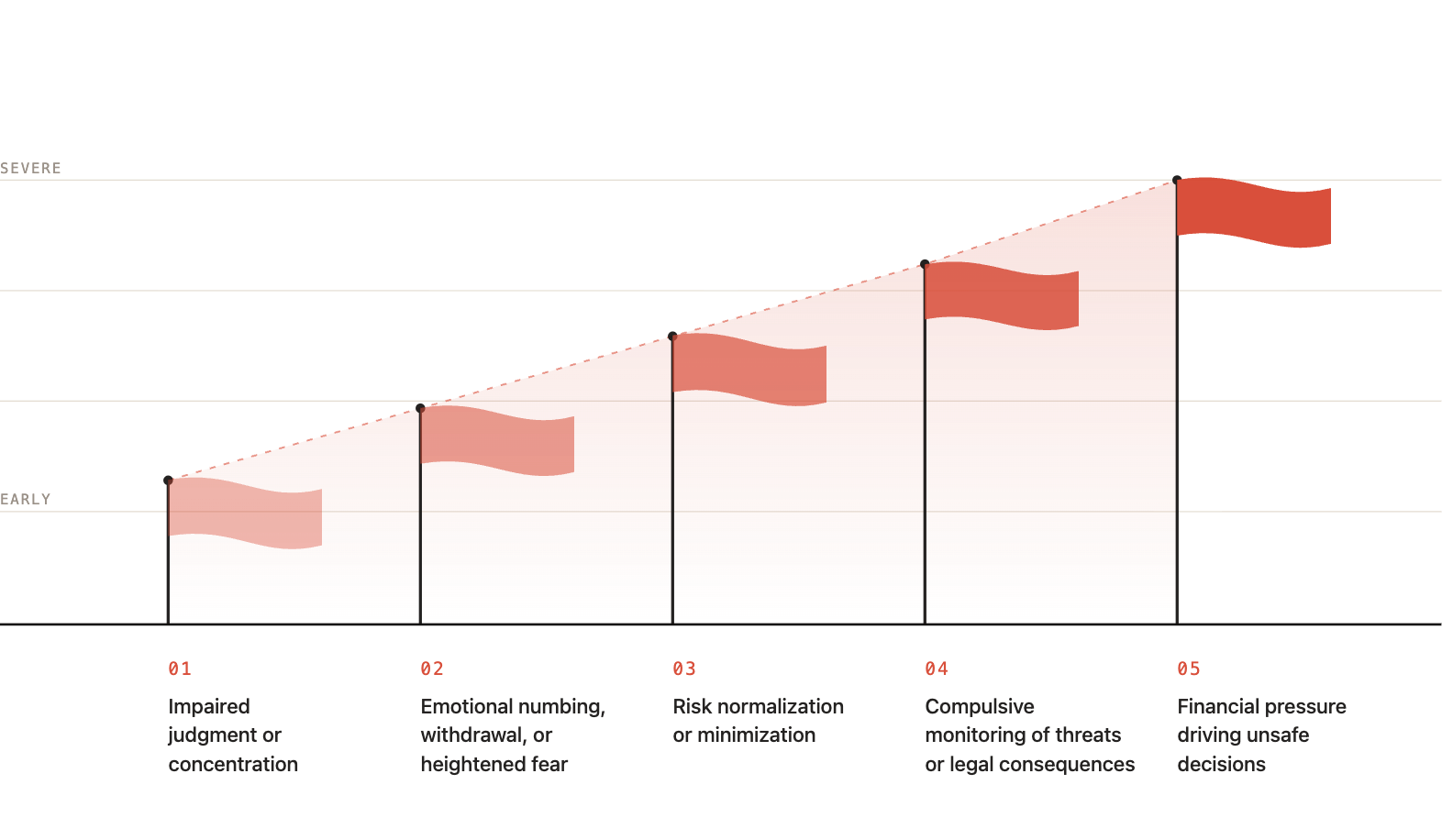
Red flags are observable indicators of elevated risk identified by experts in the field, including but not limited to:
- Impaired judgment or concentration
- Emotional numbing, withdrawal, or heightened fear
- Risk normalization or minimization
- Compulsive monitoring of threats or legal consequences
- Financial pressure driving unsafe decisions
Suggested Responses
- Any single red flag requires check-in and reassessment.
- Multiple red flags across domains strongly suggest need for modification, pause, or reassignment.
- Persistent red flags require institutional intervention, not individual coping.