Freelance Journalism and the Stress of Financial Precarity
Jump to your section:
For freelancers, financial stress is not separate from professional wellbeing. When income depends on the next assignment, an unpredictable flow of work can create a persistent state of uncertainty. A freelancer may be exhausted but unable to take a break, struggling but unable to turn down an assignment, or worried about burnout while simultaneously worrying about rent, health insurance, equipment, taxes, or an unpaid invoice.
This can create a particularly difficult cycle:
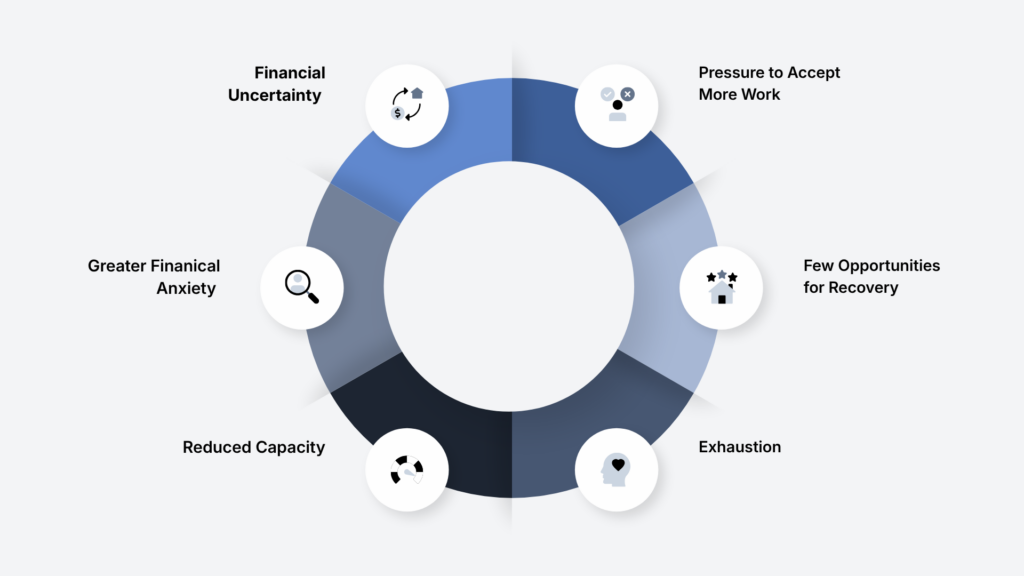
The problem is not simply having a heavy workload. It is the inability to reliably predict when the workload will exist.

job to job cycle
The “Job to Job” Stress Cycle
Freelancers may experience a constant tension between needing work and needing rest.
When an assignment comes in, the immediate response may be to accept it—even if the timing is difficult, the compensation is inadequate, or the assignment carries significant emotional or physical risk. Turning down work can feel dangerous when there is no guarantee that another opportunity will appear.
When there is no work, the pressure changes. Instead of recovering, freelancers may spend that time pitching, networking, applying, following up on unpaid invoices, searching for opportunities, or worrying about when the next paycheck will arrive.
This means that time without an assignment is not necessarily time off.
Financial uncertainty can keep the nervous system in a state of anticipation: Where is the next job coming from? When will I get paid? Can I afford to say no? What happens if this opportunity disappears?
Questions to Ask Yourself
How much of my current workload is driven by financial necessity rather than professional choice?
Do I feel able to turn down an assignment that feels unsafe, exploitative, or emotionally overwhelming?
Am I accepting work because the compensation is fair—or because I am afraid there will not be another opportunity?
How often am I working while sick, exhausted, or emotionally depleted because I cannot afford to stop?
Do I regularly work without knowing when my next income will arrive?
How much unpaid time do I spend pitching, networking, invoicing, negotiating, and looking for work?
Am I accounting for this unpaid labor when I evaluate what an assignment actually pays?
Are late payments or unclear payment terms creating additional stress?
Do I have enough financial information to understand what I actually need to earn each month?
What would make me feel slightly more financially secure?
What kinds of assignments consistently leave me depleted relative to what they pay?
What financial pressures make it difficult for me to protect my own wellbeing?
financial stress & safety
When Financial Stress Becomes a Safety Issue
Financial precarity can influence safety decisions. A freelancer who needs the income may take greater risks, work longer hours, travel without adequate preparation, accept assignments without sufficient resources, or continue covering an event after recognizing that the situation has become unsafe.
It can also affect emotional recovery. Taking a day off after difficult coverage may feel impossible if that day means losing income. Seeking professional mental health support may also feel financially out of reach.
This is why financial wellbeing belongs in a broader understanding of journalist safety. A journalist cannot always make a genuinely free safety decision when financial survival is at stake.
Create a Personal Safety Checklist
Before accepting an assignment, ask:
What will this assignment actually cost me?
Consider more than the stated fee. Factor in:
- Time spent pitching, preparing, traveling, reporting, editing, and filing
- Transportation and accommodation
- Equipment and other out-of-pocket expenses
- Unpaid administrative time
- Taxes and other deductions
- Insurance or other professional costs
- Recovery time following difficult coverage
- The opportunity cost of being unavailable for other work
Is the actual compensation worth the time, risk, and resources this assignment requires?
This is not about judging yourself for accepting work you need. Financial necessity is real. The purpose is to make the tradeoffs visible so that you can make decisions with as much information and agency as possible.
Remember: Rest Is Not Always “Free Time”
For a freelancer living assignment to assignment, taking time away from work can produce its own anxiety. But chronic exhaustion can eventually make it harder to report, pitch, photograph, write, make decisions, and sustain relationships with editors and sources.
Recovery is part of maintaining the ability to continue doing the work. The Reporting with Resilience framework similarly identifies recovery, reflection, connection, and peer support as important parts of long-term wellbeing.
The goal is not to pretend that freelancers can simply “take a mental health day” when missing a day’s income may have consequences. Instead, it is to recognize the structural pressure that makes recovery difficult—and to build whatever small protections are possible around it.
Ask Yourself Regularly
Am I building a sustainable freelance career, or am I simply surviving from one assignment to the next?
That distinction matters. Financial precarity can become so normalized that exhaustion begins to feel like an unavoidable part of being a freelancer. Recognizing the connection between money, workload, risk, and wellbeing is the first step toward changing that cycle.